
How Upcycled Art Is Building a Circular Economy in India

A discarded piece of fabric, a broken wooden panel, an old bicycle part, or a pile of packaging waste may look like something that has reached the end of its useful life.
For an artist, it can be the beginning of something else.
Across India, artists and creative entrepreneurs are experimenting with materials that would otherwise be thrown away, turning waste into sculptures, installations, furniture, paintings, accessories, and functional objects. The practice is usually called upcycling, but its significance goes beyond creating something attractive from discarded material.
It represents a different way of thinking about resources.
Instead of asking what can be made from newly purchased materials, upcycling asks what can be created from materials that already exist.
That makes the practice particularly interesting in a country dealing with enormous volumes of waste while also developing new circular economy models.
What Makes Upcycled Art Different?
Upcycling is often confused with recycling, but the two approaches are not quite the same.
Recycling generally involves processing waste back into a material that can be used to manufacture something new. Upcycling attempts to retain more of the original material’s form, character, or value by transforming it into something different without reducing it to its basic raw material.
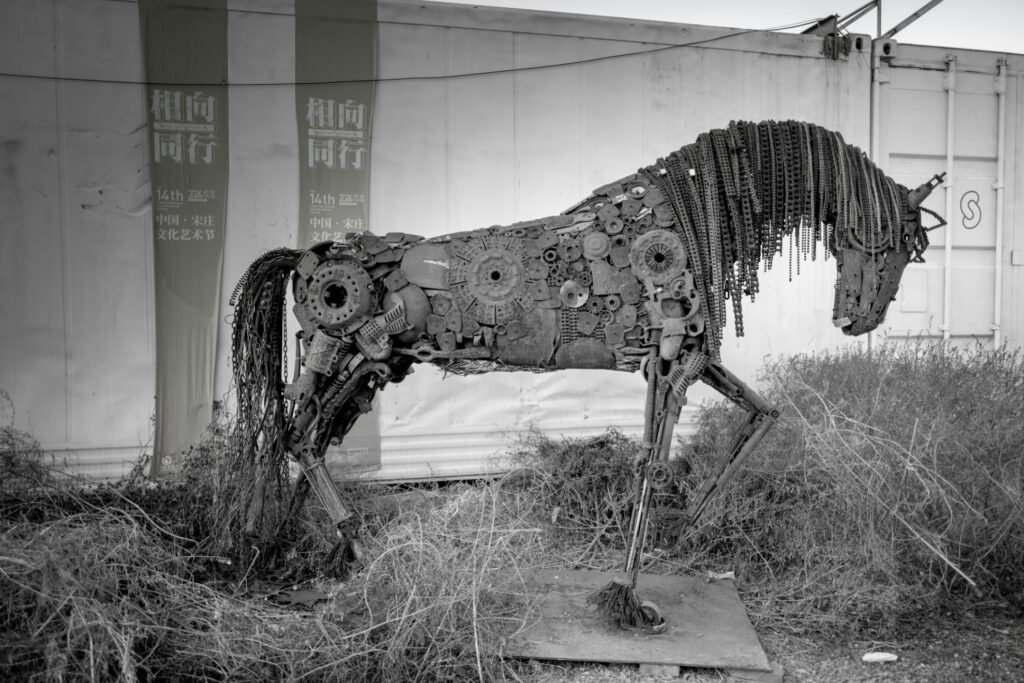
An old wooden door might become part of a dining table. Discarded fabric could become an installation. Broken metal components might become a sculpture. Packaging waste could become the raw material for an artwork.
The creative process changes the perceived value of the material.
What was previously considered waste becomes a resource.
This fits closely with the principles of a circular economy, which aims to eliminate waste and pollution, keep products and materials circulating at their highest value, and regenerate natural systems. The Ellen MacArthur Foundation’s explanation of the circular economy provides a useful framework for understanding why reuse and material recovery are important beyond conventional recycling.
For artists, this concept can be applied at a very tangible level. The material is already sitting somewhere in the economy. The challenge is finding another use for it.
Why Waste Can Become an Artistic Resource
Artists have always worked with materials that other people overlook.
The difference today is that waste itself is becoming an increasingly deliberate part of the creative process.
This can happen for practical reasons. Discarded materials can be inexpensive or even free. A furniture workshop may have wood offcuts that it cannot economically use. A garment manufacturer may generate fabric scraps in large quantities. Construction sites can produce leftover materials that have no immediate use.
For an artist, these leftovers can offer something that newly manufactured materials cannot: variation.
A piece of reclaimed wood might carry marks from its previous use. Old metal can have a particular texture or patina. Used textiles can contain different colors, patterns, and fibres. Packaging materials can introduce unexpected shapes and surfaces.
Instead of treating these imperfections as defects, artists can make them part of the work.
That changes the creative process from simply selecting a material to discovering what can be done with material that already has a history.
India Has a Huge Material Pool to Work With
India’s waste challenge provides a difficult backdrop for this movement, but it also means there is an enormous variety of materials moving through the economy.
UNDP India estimates that the country generates around 62 million tonnes of waste annually, with solid waste, plastic, and e-waste among the major waste streams. Waste collection and recovery also involve a large informal workforce, which plays an important role in moving recyclable materials back into the economy. UNDP India’s overview of waste management and circularity highlights both the scale of the challenge and the role of waste workers in recovering materials.
For artists, this means potential raw materials exist in almost every part of the economy.
Textile manufacturing creates scraps. Construction creates offcuts. Retail creates packaging. Electronics create discarded components. Hospitality businesses discard furniture and other materials. Households dispose of objects that may still have useful physical properties.
The difficult part is not necessarily finding waste.
It is building a reliable way to collect, sort, clean, store, and transform it.
That is where upcycled art starts becoming more than an artistic practice.
From Waste Material to Creative Material
One of the most interesting developments is the shift from thinking of waste as an object to thinking of it as a material category.
An artist may not want “old furniture.” They may want reclaimed wood with particular dimensions.
A textile artist may not simply want “fabric waste.” They may need cotton scraps, denim offcuts, or a particular colour range.
A sculptor may not need “metal waste.” They may be looking for discarded industrial components with specific shapes and properties.
This distinction matters because a functioning creative business needs consistency.
If an artist wants to produce ten similar pieces, randomly finding ten suitable discarded objects may not be enough. They need access to a predictable material stream.
That creates an opportunity for relationships between artists and the businesses generating waste.
A furniture manufacturer could separate usable wood offcuts rather than sending them into the general waste stream. A garment manufacturer could collect textile scraps by type and colour. A packaging company could identify clean materials suitable for creative reuse.
The artist gets a source of material.
The business gets another potential pathway for material that would otherwise have little value.
The Artist Can Become Part of the Supply Chain
This is where upcycled art starts intersecting with sustainable business.
Imagine an artist who begins by making sculptures from discarded industrial metal. Initially, the work may be sold directly to individual collectors.
Over time, the artist develops a reliable process and realizes that the same material can be used to create installations for offices, retail spaces, hotels, restaurants, or architectural projects.
The business has now changed.
The artist is no longer only selling individual artworks. They are providing a creative solution to another business.
The same thing could happen with reclaimed wood, textile waste, discarded plastic, paper, packaging materials, or electronic components.
An upcycling studio could eventually work with interior designers. A textile artist could collaborate with fashion companies. A furniture maker could work directly with manufacturers to recover production offcuts. A creative workshop could provide corporate installations using a company’s own waste materials.
These are B2B relationships, and they can open a completely different market from selling individual artworks online.
Discoverability Becomes Important
Once an upcycling practice becomes a business, having the right material or capability is only part of the equation.
Potential customers need to be able to find the business.
This can be particularly important for small studios because the organizations that need their services may not be searching for an “artist.” They might be looking for reclaimed materials, sustainable interior solutions, circular design services, custom installations, waste-to-product solutions, or creative partners for a sustainability project.
Being visible in the right business ecosystem can therefore matter.
B2B-focused platforms such as NatNavi can give sustainability-focused businesses another place to present their capabilities and become discoverable to potential buyers, partners, and organizations looking for relevant solutions.
For an upcycling business, the value is not simply being listed as an “eco-friendly company.” It is being clear about what the business can actually provide.
For example, a profile could explain that a studio converts textile production waste into custom installations for commercial interiors. Another business might specialize in transforming industrial wood offcuts into furniture. A third could provide corporate art installations made from a client’s own discarded materials.
The more specific the offering, the easier it becomes for another business to understand whether there is a potential fit.
The B2B Opportunity Goes Beyond Selling Art
The commercial opportunity around upcycling does not necessarily have to involve selling finished artwork.
There are several layers to the value chain.
An artist might source waste and turn it into finished products.
Another business might process discarded material into a usable secondary material.
A design studio might use those materials in interiors.
An architect might specify reclaimed components in a project.
A company might commission an installation that communicates its sustainability story.
A workshop might teach employees how to reuse the organization’s own waste materials.
These activities can involve completely different customers while sharing the same underlying principle: keeping existing materials in use for longer.
This is one reason the circular economy is broader than recycling.
The objective is not simply to prevent something from entering a landfill. It is to retain the economic and functional value already embedded in materials for as long as possible.
Upcycling Can Create Value From Material History
There is also something particularly interesting about waste-based art that goes beyond environmental impact.
The material’s previous life can become part of the story.
A sculpture made from components recovered from an old factory carries a different narrative from one produced using newly manufactured metal. Furniture made from reclaimed timber can retain marks, textures, and imperfections from its earlier use.
For commercial buyers, this can create an additional dimension of value.
A hotel may want a locally sourced installation with a connection to the history of its region. A company may want an artwork made from materials recovered from its own facility. A restaurant may commission furniture made from reclaimed materials associated with the building’s previous use.
The waste is no longer invisible.
Its history becomes part of the product.
But Upcycled Does Not Automatically Mean Sustainable
There is an important distinction here.
Using discarded material can reduce demand for newly sourced materials in some situations, but it does not automatically make a product environmentally sustainable.
An artist might use waste material but rely heavily on new synthetic coatings, energy-intensive processing, long-distance transportation, or excessive packaging.
The environmental benefit also depends on what would have happened to the material otherwise and what resources are required to transform it.
This is why responsible upcycling businesses should be specific about their practices rather than making broad claims.
Instead of simply describing a product as “100% sustainable,” it is more useful to explain what material was recovered, how much was reused, where it came from, and what transformation was carried out.
That gives buyers a clearer understanding of the actual environmental contribution.
The People Behind the Waste Matter Too
There is another side of the circular economy that is easy to miss when discussing upcycled art.
Waste does not move itself.
In India, waste pickers and other informal workers play a significant role in collecting, sorting, and recovering materials. UNDP has estimated that around 4 million Safai Sathis contribute to India’s recycling and waste management systems, while also highlighting the difficult working conditions and lack of formal recognition many face.
This means a responsible circular model needs to consider not only the material but also the people involved in recovering it.
An artist sourcing material from a waste worker, recycler, scrap dealer, or recovery facility is participating in a larger value chain.
Building fair and transparent relationships within that chain can be just as important as choosing the material itself.
The circular economy should not simply move waste from one place to another. It should create systems in which materials retain value while the people handling them are treated fairly.
What Happens When Artists Scale?
Scaling an upcycling business presents a different challenge from starting one.
At a small scale, an artist can work with whatever materials happen to be available.
At a larger scale, consistency becomes important.
Customers may expect similar dimensions, quality, colours, finishes, and delivery times. A business cannot always depend on finding exactly the right discarded material at exactly the right moment.
This is where relationships with suppliers become important.
An artist may establish agreements with manufacturers to receive specific waste streams. A furniture studio might arrange regular collection of wood offcuts from several workshops. A textile business might develop a sorting process that turns mixed production waste into usable categories.
The business gradually starts behaving like a small circular supply chain.
That transition can be difficult, but it also creates opportunities for specialization.
Instead of one artist trying to collect every type of waste, different businesses can focus on collection, processing, design, manufacturing, or finished products.
From Individual Artist to Circular Business
The most interesting future for upcycled art may therefore sit somewhere between art and entrepreneurship.
An artist can start with a creative experiment.
That experiment can become a product.
The product can become a business.
The business can develop relationships with material suppliers and commercial buyers.
And eventually, what started as one person finding a new use for discarded material can become part of a larger circular value chain.
This does not mean every artist needs to turn their practice into a company. Many artists will continue working independently, producing one-off pieces and experimenting with materials simply because that is how they want to create.
But for those who want to build businesses around upcycling, the opportunity extends far beyond the traditional art market.
The Next Opportunity May Be in the Material Itself
One of the biggest possibilities is that artists and creative entrepreneurs could increasingly become material innovators.
Instead of simply taking an old object and turning it into another object, they can develop repeatable methods for transforming waste into useful materials.
Textile scraps could become panels or composite materials.
Agricultural residues could become surfaces or craft materials.
Discarded plastic could become sheets, tiles, or design components.
Industrial offcuts could become standardized furniture components.
This moves the business closer to manufacturing and material innovation.
The customer may no longer be an individual looking for a piece of art. It could be a designer, architect, furniture company, fashion brand, hospitality business, retailer, or corporate buyer looking for a particular material or capability.
That is where the boundary between art, design, manufacturing, and sustainable business begins to blur.
India’s Upcycled Art Movement Is About More Than Waste
Upcycled art is often presented as a creative response to India’s waste problem.
It is that, but it can also be something bigger.
It demonstrates that the value of a material does not necessarily disappear when its first intended use ends. With creativity, technical knowledge, and the right business relationships, discarded materials can enter another stage of their economic life.
For artists, that can mean new creative possibilities.
For manufacturers, it can mean another pathway for production waste.
For designers, it can mean access to unusual materials.
For businesses, it can create new partnerships and products.
And for the circular economy, it represents exactly the kind of thinking needed to move away from a simple take, make, and discard model.
The real opportunity is not just to make beautiful things from waste.
It is to build systems where waste becomes a source of material, material becomes a source of creativity, and creativity can become a source of new business value.





Responses