

How to Buy Original Fine Art Online Wisely: The Complete Collector’s Guide

Buying art online can feel intimidating, especially if you’re making your first serious purchase. The internet has opened up incredible opportunities for collectors to discover artists from around the world, but it has also created new challenges. How can you tell if a painting is truly original? Is the price justified? How do you avoid ending up with a mass-produced print instead of an authentic artwork?
If you’re looking to buy original fine art online, the good news is that you don’t need to be an experienced collector to make smart decisions. Today, anyone can buy original fine art online safely and confidently by focusing on three essential factors: verifying provenance, confirming artist authenticity, and purchasing through curated art platforms rather than unregulated marketplaces.
Whether you’re purchasing your first painting or expanding an existing collection, this guide will help you navigate the process with confidence.
1. Look for Independent Art Curation (Avoiding the “Open Marketplace” Trap)
One of the biggest mistakes first-time collectors make is assuming that every online art platform operates with the same standards.
Many open marketplaces allow anyone to create a seller profile, upload images, and list artwork for sale. While these platforms offer variety, they often place the burden of verification entirely on the buyer. Without proper oversight, collectors may struggle to distinguish between genuine artistic talent, decorative reproductions, and inflated pricing.
Curated art platforms operate differently.
Instead of accepting every submission, curated platforms employ experienced reviewers, art professionals, and selection panels who evaluate artists before their work is presented to collectors. This process helps ensure that the artworks meet established standards for artistic quality, originality, craftsmanship, and market positioning.
At ArtD’Hope, every artist undergoes a careful review process conducted by an independent curation panel. This evaluation extends beyond aesthetics to include material quality, artistic consistency, durability of the medium, and fair market valuation. Such vetting provides collectors with greater confidence that the artwork they are purchasing represents genuine creative value rather than speculative pricing.
This approach also helps answer a common concern among buyers: How do I know if an online artwork is overpriced?
Pricing in fine art should never be arbitrary. When evaluating an artwork, consider factors such as:
- The artist’s exhibition history and career progression
- Consistency and quality of their body of work
- Complexity of the medium and technique
- Rarity and uniqueness of the piece
- Whether an experienced curation panel has reviewed and validated the pricing structure
Professional curation introduces accountability into the process, helping collectors avoid paying premium prices for works that lack long-term artistic or collectable value.
Collector’s Rule #1: If a website doesn’t have an internal review process for its creators, you are buying a product—not necessarily an investment-grade piece of fine art.
2. Verify Authenticity and Provenance
Authenticity is one of the most important considerations when purchasing original art online.
A beautiful painting may catch your eye, but serious collectors always ask a deeper question: Can this artwork’s origin be verified?
This is where provenance becomes essential.
In simple terms, provenance is the documented history of an artwork. It serves as a paper trail that records the artwork’s creator, ownership history, exhibition records, and any significant transactions related to the piece. Strong provenance helps establish legitimacy and protects the artwork’s future value.
A critical part of provenance is the Certificate of Authenticity (CoA).
A Certificate of Authenticity is a document signed by the artist or gallery stating the artwork’s title, dimensions, medium, and exact creation date. It serves as formal proof that the artwork is an original creation and not a reproduction.
When purchasing original paintings online, always confirm that the artwork includes:
- A signed Certificate of Authenticity
- Artist verification documentation
- Detailed artwork specifications
- Provenance records, where applicable
- Professional condition reporting for high-value works
The art world is also embracing new technologies to strengthen authenticity.
The Rise of Phygital Art and Blockchain Verification
Modern collectors are increasingly seeking additional layers of security beyond traditional paperwork. This has led to the emergence of “phygital” art—physical artworks paired with blockchain-based digital assets.
In this model, a physical canvas is linked to a unique digital token that functions as a secure digital twin of the artwork. Because blockchain records are immutable, ownership and authenticity can be tracked with greater transparency over time.
Collectors interested in learning more about this evolution can explore ArtD’Hope’s Phygital Art and Meta Canvas ecosystem through the relevant educational resources available on the platform.
For many buyers, this combination of physical and digital verification creates a stronger chain of authenticity than traditional documentation alone.
This also addresses another common concern among first-time collectors: Is it safe to buy original paintings online?
The answer is yes—provided you purchase through platforms that offer secure payment systems, verified artist profiles, documented authenticity procedures, and insured shipping specifically designed for fragile fine art. Reputable curated galleries significantly reduce the risks associated with online art purchases by introducing professional oversight at every stage of the transaction.
3. Understand the Medium and Scale Before You Click “Buy”
One of the most overlooked aspects of buying art online is understanding how the artwork will actually look in your space.
A painting that appears monumental on a smartphone screen may arrive looking surprisingly small on a large living room wall. Likewise, an oversized canvas can overwhelm a space if dimensions aren’t carefully considered beforehand.
Before purchasing, pay close attention to both the medium and the scale of the artwork.
Evaluate the Medium
Different artistic mediums create very different visual experiences.
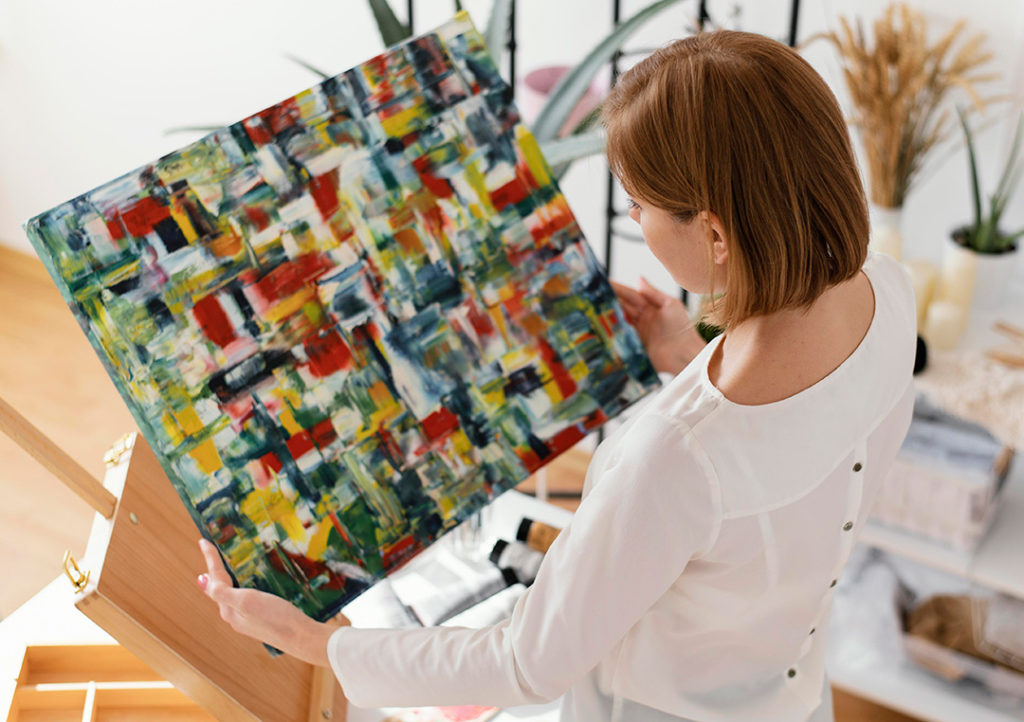
A heavily textured abstract acrylic painting may have dramatic surface depth that photographs struggle to capture. Layered oil paintings often reveal subtle brushwork and tonal transitions visible only at close range. Watercolours, on the other hand, offer delicate transparency and softness that can be difficult to appreciate from standard product images.
Whenever possible, request:
- High-resolution detail photographs
- Close-up images of brushwork and texture
- Side-angle photographs showing depth and layering
- Framed and unframed presentation views
These additional visuals provide a much more accurate understanding of the artwork’s physical presence.
Use the Painter’s Tape Method
Professional interior designers often recommend a surprisingly simple technique before purchasing artwork online.
Measure the artwork’s dimensions and recreate its outline on your wall using blue painter’s tape.
This exercise instantly reveals whether the scale feels appropriate for the intended location. It helps avoid costly mistakes and gives you a realistic preview of how the piece will interact with furniture, lighting, and surrounding decor.
A few minutes of planning can dramatically improve satisfaction with your final purchase.
4. Know Where Your Money Goes: Supporting the Artist Directly
Every art purchase is more than a transaction—it is a direct investment in creativity.
Many large-scale decor retailers and mass-production art sites operate on high-volume business models that prioritize margins over artists. In some cases, creators receive only a small fraction of the final sale price while intermediaries retain the majority of the revenue.
For socially conscious collectors, this raises an important question: Who truly benefits from your purchase?
When you choose to buy original paintings online through artist-focused platforms, a significantly greater portion of the purchase supports the creator’s career, studio practice, and future work.
At ArtD’Hope, this principle sits at the heart of the platform’s mission.
Through its foundation-driven ecosystem, ArtD’Hope connects collectors with independent artists from around the world while fostering a sustainable environment for creative growth. Every acquisition contributes not only to an artist’s livelihood but also to a broader global network dedicated to cultural exchange, artistic empowerment, and long-term creative development.
Rather than simply purchasing decorative objects, collectors become active participants in a larger movement that values originality, authenticity, and human creativity.
The decision to buy original fine art online should never feel like a gamble.
By choosing curated platforms, verifying authenticity and provenance, understanding the artwork’s physical characteristics, and supporting artist-centered ecosystems, collectors can make informed decisions with confidence.
The most successful art purchases happen when emotional connection meets careful due diligence. When both factors align, you’re not simply acquiring a painting—you are preserving a story, supporting a creator, and investing in a piece of cultural expression that can be enjoyed for generations.
For collectors seeking transparency, verified authenticity, curated quality, and meaningful impact, ArtD’Hope offers a trusted pathway into the world of original fine art collecting.





Responses